
The warming climate shifts the dynamics of tundra environments and makes them release trapped carbon, according to a new study published in Nature. These changes could transform the tundra biome from carbon sinks into a carbon source, exacerbating the effects of climate change. Among the authors of the study are scientists from the University of Iceland and the Agricultural University of Iceland.
A team of over 70 scientists used open-top chambers (OTCs) to experimentally simulate the effects of warming on 28 tundra sites around the world within the International Tundra Experiment-network (ITEX). OTCs basically serve as mini-greenhouses, blocking wind and trapping heat to create local warming.
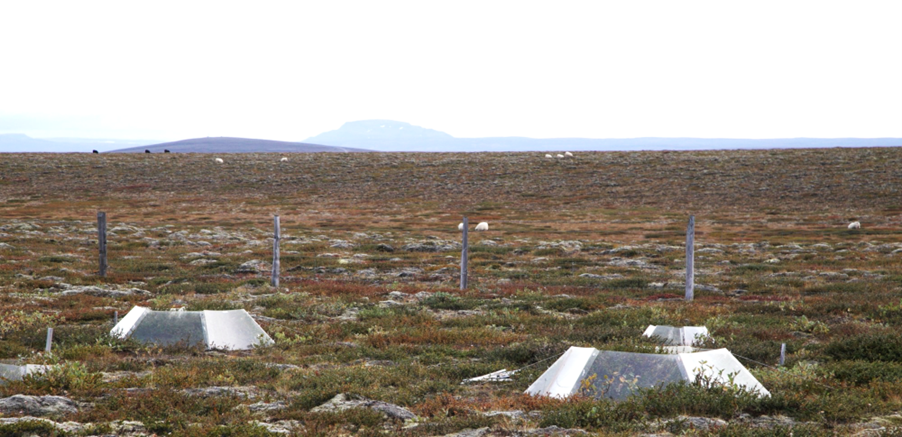
Open-top chambers (OTCs) in Audkúluheiði, Iceland, established in 1996, provide a controlled environment to study simulated warming of the tundra ecosystem.
The warming experiments led to a 1.4°C increase in air temperature and a 0.4°C increase in soil temperature, along with a 1.6% drop in soil moisture. These changes boosted ecosystem respiration by 30% during the growing season, causing more carbon to be released because of increased metabolic activity in soil and plants. The changes persisted for at least 25 years after the start of the experimental warming – which earlier studies hadn’t revealed.
Ingibjörg Svala Jónsdóttir, Professor at the Facultly of Life and Enviromental Sciences, University of Iceland, was the priciple investigator in Iceland and at four sites in Svalbard and there the results were not as clear cut. Measurements at the Icelandic highlands that were done in collaboration with Jón Guðmundsson and Hlynur Óskarsson from the Agricultural University of Iceland showed small responses to warming. Some time has elapsed since those measurements were done (2008) and they will be repeated next summer in collaboration with researchers from the University of Gothenburg.
