An international group of scientists, including one from the University of Iceland, has for the first time correctly determined the age of whale sharks. It was atomic bomb tests conducted during the Cold War that played a surprising part in the discovery which will hopefully help ensure the survival of the species, now classified as endangered.
The discovery is published in the journal Frontiers in Marine Science, and among the authors is Steven Campana, professor at the University of Iceland Faculty of Life and Environmental Sciences.
Measuring the age of whale sharks (Rhincodon typus) has been difficult because, like all sharks and rays, they lack bony structures called otoliths that are used to assess the age of other fish.
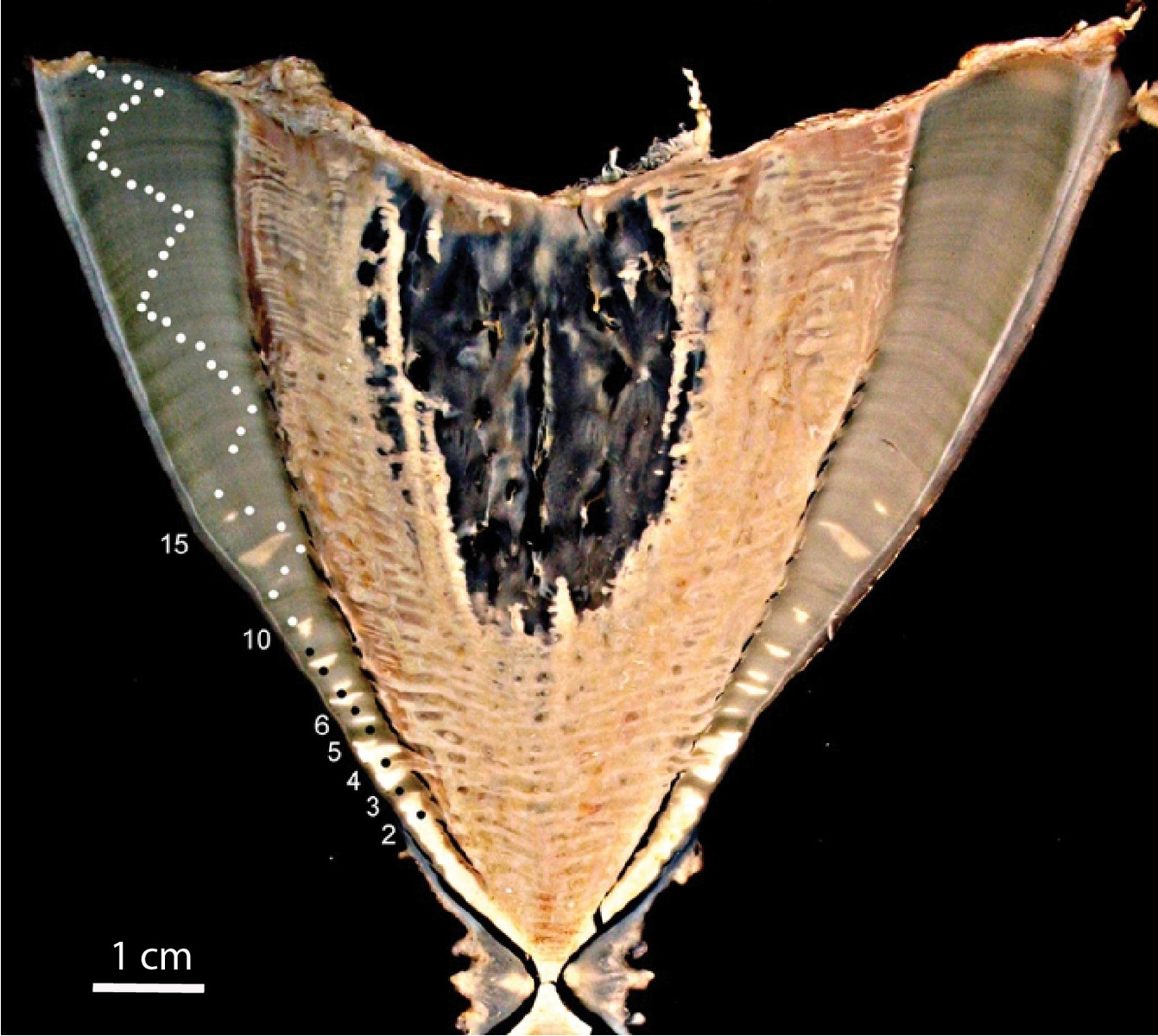
Whale shark vertebrae feature distinct growth bands – a little like the rings of a tree trunk – and it was known that these increased in number as the animal grew older. However, some studies suggested that a new ring was formed every year, while others concluded that it happened every six months.
To resolve the question, a team of researchers led by Joyce Ong from Rutgers University in New Jersey, USA, Steven Campana from the University of Iceland, and Mark Meekan from the Australian Institute of Marine Science in Perth, Western Australia, turned to the radioactive legacy of the Cold War’s nuclear arms race.
Radiocarbon plays a key-part in the dating approach
"Sharks have been a passion of mine my entire life, but my interest really took off when I became head of the Canadian Shark Research Laboratory many years ago," says Steven who is among the most prestigious scientists in the world in the field of sharks and the age determination of fish species, including Icelandic fishes. He has been a professor at the University of Iceland's Faculty of Life and Environmental Sciences for the last five years. "Although my research at the University of Iceland over the past 5 years has focused more on Icelandic fish species like cod, I continue my international research on sharks and shark populations, in particular new methods for tracking them electronically and for determining how old they are. One of the methods that we developed years ago was to take advantage of radioactive remnants of Cold War atomic bomb testing that exist at extremely low levels everywhere in the world, and use them to confirm ages of sharks and other fishes," says Steven.
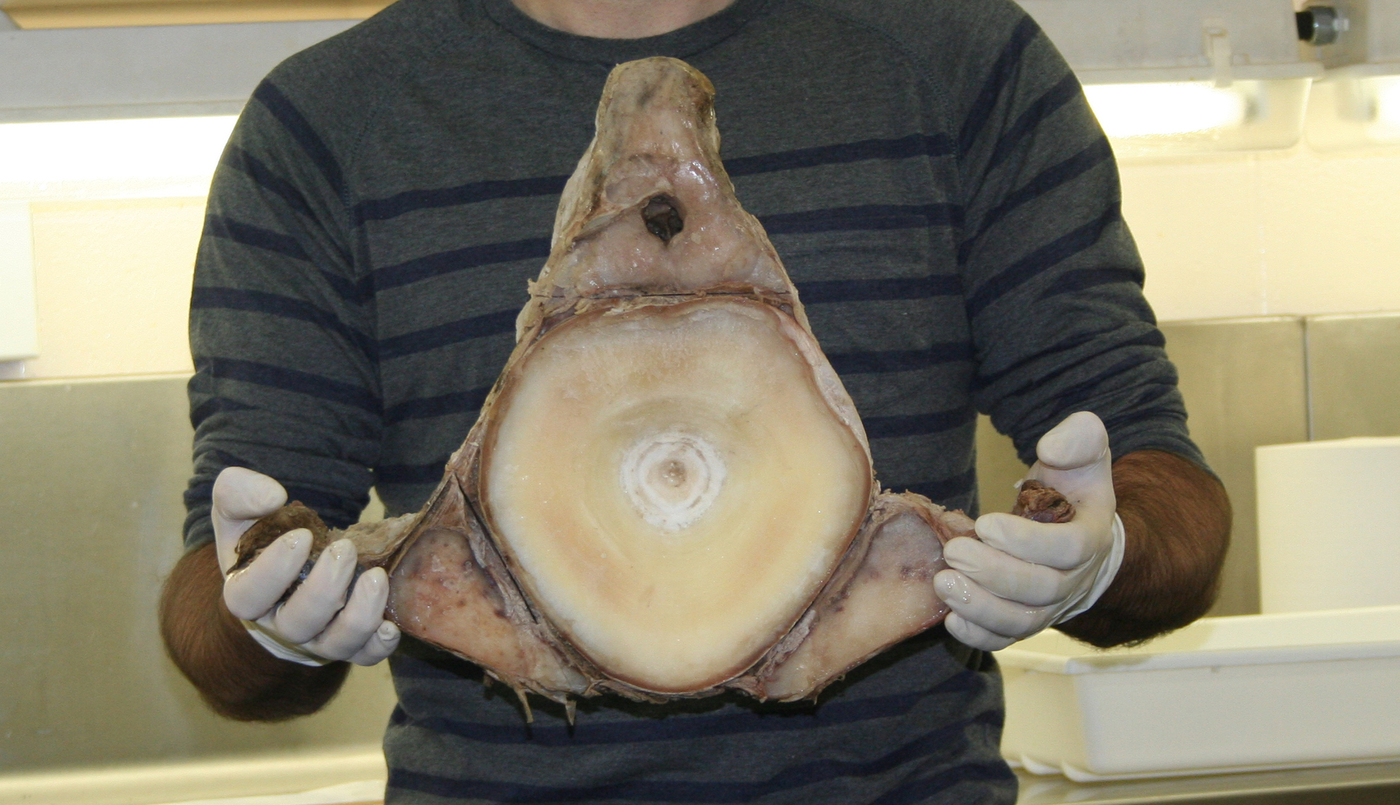
The vertebra of the whale shark is no small matter and feature distinct growth bands, a little like the rings of a tree trunk.
The method in question is based on a special kind of carbon, or an isotope called carbon-14, or radiocarbon. The radioactive isotope can be found in nature, e.g. in ancient animal bones. Its rate of decay is often used by archaeologists and historians to date ancient bones and artefacts.
During the 1950s and 1960s, the USA, the USSR, the UK, France and China conducted tests of nuclear weapons. Many of these were explosions detonated several kilometres in the air. One powerful result of the blasts was the temporary atmospheric doubling of the carbon-14 isotope. Fallout from the Cold War tests saturated first the air, and then the oceans. The isotope gradually moved through food webs into every living thing on the planet, producing an elevated carbon-14 label, or signature, which still persists.